As immigration practitioners, we often navigate complex scenarios involving remote work, concurrent employment, and cross-border self-employment; situations that test how the Express Entry system distinguishes between Canadian and foreign work experience.
In April 2025, I contacted the Immigration Representatives Mailbox (ImmReps) to request clarification on whether an applicant can get CRS points for overlapping full-time Canadian and foreign work experience under Express Entry. I received the response recently.
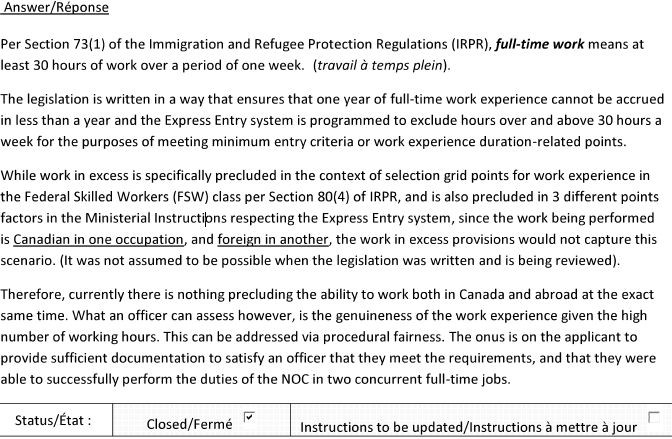
About three months after my inquiry, Steven Meurrens, shared the IRCC Functional Guidance dated January 30, 2024, which confirmed a similar interpretation: that there is nothing precluding an applicant from working both in Canada and abroad at the same time, provided each job meets the respective program criteria.
Below is the summary of the correspondence I received from ImmReps, which is provided at the end of this post for reference.
Concurrent Canadian and Foreign Work Experience
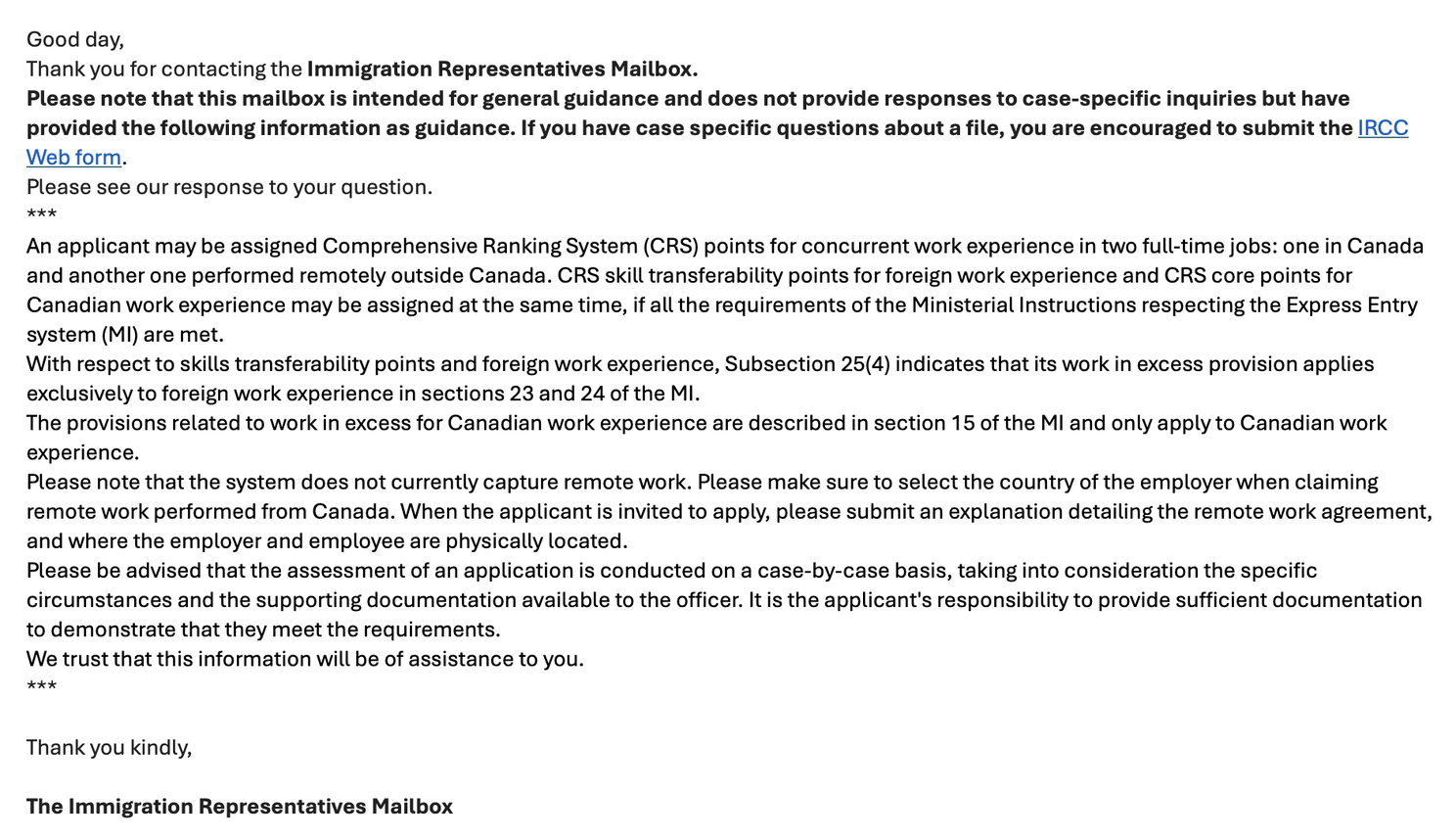
The ImmReps response confirmed that an applicant can be assigned CRS points for two concurrent full-time jobs, one in Canada and another performed remotely for a foreign employer, if all the requirements of the Ministerial Instructions respecting the Express Entry system (MI) are met.
Specifically:
- CRS core points may be awarded for Canadian work experience, and
- CRS skill transferability points may be awarded simultaneously for foreign work experience.
However, the system does not currently capture remote work directly. Applicants should therefore:
- Select the employer’s country when claiming remote work performed from Canada, and
- Include a detailed explanation of the arrangement (e.g., employer and employee locations, work terms).
IRCC emphasized that assessments are case-specific, and applicants must provide supporting documentation to demonstrate eligibility.
This aligns with the January 2024 Functional Guidance shared by Steven Meurrens, which explained that because the “work in excess” provisions don’t capture situations where one job is Canadian and the other is foreign, there’s currently no regulatory barrier preventing concurrent employment in both contexts.
Remote and Self-Employed Foreign Work Experience
In a second inquiry, I also sought clarification on whether remote or self-employed work for foreign clients can qualify as foreign work experience under the CRS.
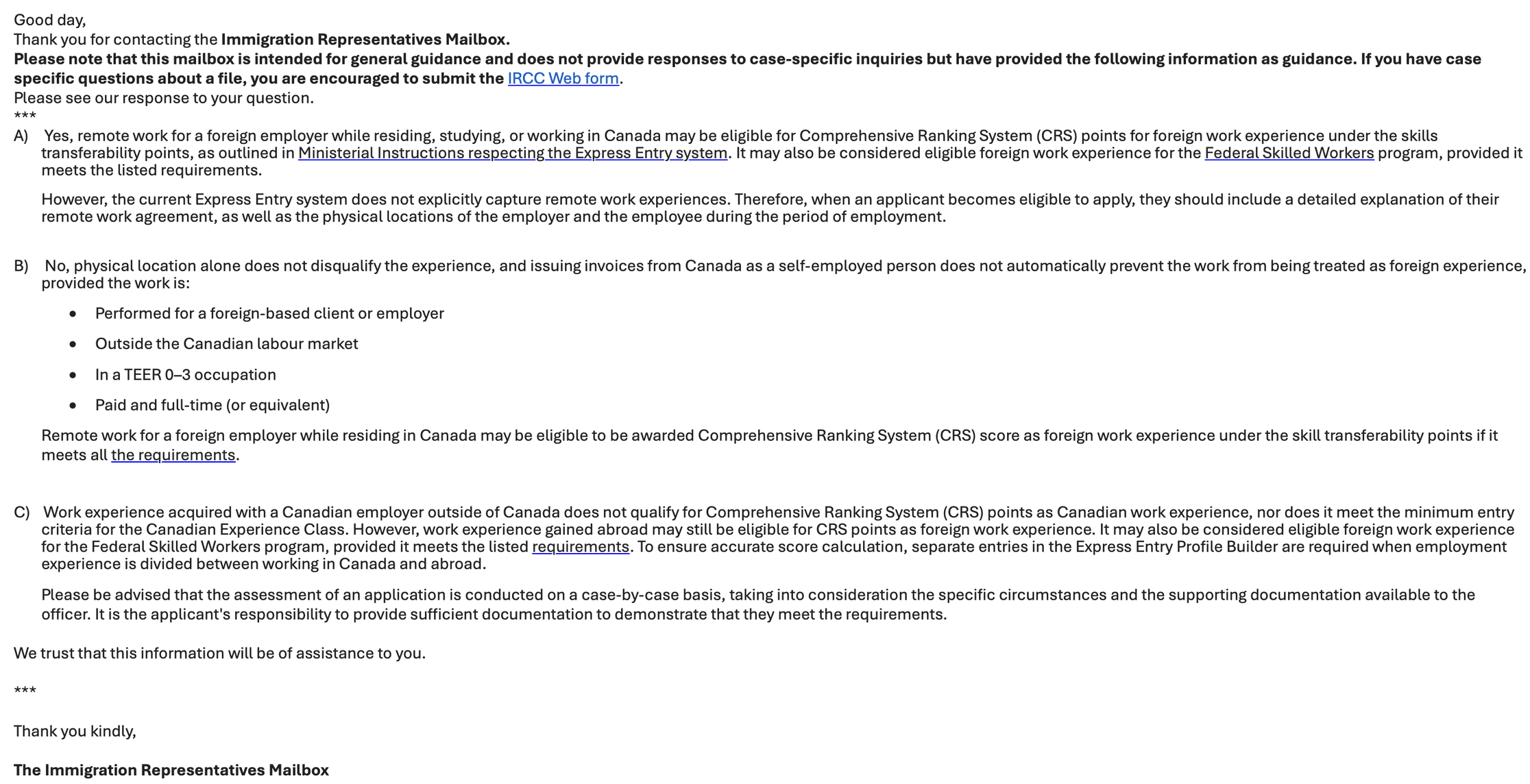
ImmReps confirmed that remote work for a foreign employer or client may count as eligible foreign work experience, even if performed from within Canada, provided it meets all standard criteria (paid, full-time or equivalent, TEER 0–3 occupation).
Key clarifications:
- Physical presence in Canada does not automatically disqualify the experience.
- Issuing invoices from Canada as a self-employed individual also does not prevent it from being treated as foreign experience, so long as the work is: For a foreign-based employer or client, Conducted outside the Canadian labour market, and Fully documented.
- Conversely, work performed abroad for a Canadian employer does not count as Canadian experience; however, it may still qualify as foreign experience if it meets the relevant requirements.
As with concurrent experience, IRCC encourages applicants to clearly explain the work arrangement, including the physical locations of both parties.
Takeaway
Together, these responses, from both IRCC Functional Guidance (January 2024) and ImmReps (2025), reflect a growing recognition of modern, globalized work arrangements within the Express Entry framework.
Although the system itself doesn’t yet have a field dedicated to remote work, IRCC’s position indicates that such experience can be credited appropriately, whether concurrent, remote, or self-employed, provided it’s well-documented and clearly aligned with the definitions outlined in the Ministerial Instructions.
For me, the area that had remained most uncertain was self-employment in Canada while serving foreign clients. I was initially reluctant to treat this as foreign work experience, since the applicant is physically in Canada and invoices are issued from here. In my mind, this seemed different from being on a foreign employer’s payroll, where the employment relationship and reporting structure are clearly established abroad. But on the other hand, self-employment outside Canada has always been considered valid foreign work experience, and it doesn’t depend on where the work is physically performed; what matters is which labour market the work is tied to.
I’m sharing this to help clarify how IRCC is currently interpreting scenarios that are becoming increasingly common in global work arrangements, and how immigration policy is gradually adapting to reflect this shift.
To give full context, I’ve included both my inquiries and the ImmReps answers below.
Clarification Request Regarding Response IRCC REP-2024-1152 - REP-B-2025-0547
I am writing regarding an ImmReps response (REP-2024-1152) that I read through my professional network and would appreciate your clarification on one point.
The original question and your answer were as follows:
Question: Can an applicant accumulate foreign work experience and Canadian work experience concurrently?
Answer: An applicant may claim concurrent work experience for two full-time jobs: one in Canada and one performed remotely outside Canada. Depending on the applicant's qualifications, the system may grant them CRS skill transferability points for foreign work experience and CRS core points for Canadian work experience at the same time.
The system will not grant additional Federal Skilled Worker Program selection criteria points for work experience in excess of 30 hours per week.
My Question:
This response only mentions not granting additional Federal Skilled Worker Program selection criteria points for work experience in excess of 30 hours per week. However, it does not appear to fully address the application of Section 25(4) of the Ministerial Instructions to overlapping full-time Canadian and foreign work experience for the purposes of awarding CRS skill transferability points.
Specifically: Section 25(4) addresses work experience under Sections 23 and 24, which deal with skill transferability points. Section 24, in particular, covers the combination of Canadian and foreign work experience points. According to Section 25(4), simultaneous periods of work experience in more than one full-time job are evaluated as a single period of full-time work in one occupation, regardless of whether the work is in different jurisdictions.
While Section 15(6) applies a similar principle to Canadian work experience, Section 25(4) is the more relevant provision for understanding how foreign work experience is combined with Canadian experience. This suggests that CRS skill transferability points for Canadian and foreign work experience cannot be awarded separately for overlapping periods.
While I understand that CRS core points for Canadian work experience may be awarded independently, my concern relates specifically to the treatment of overlapping periods under the skill transferability factors, where Section 25(4) appears to require evaluation as a single period of full-time work.
Could you please clarify whether, under the current system, overlapping full-time Canadian and foreign work experience periods can be separately credited toward CRS skill transferability points?
Clarification on Foreign Work Experience – Scenarios Involving Self-Employment and Remote Work - REP-B-2025-1333
I am seeking clarification on how IRCC assesses foreign work experience for the purposes of CRS skill transferability points under Express Entry.
Specifically, I would like to confirm whether physical presence in Canada and issuing invoices as a self-employed individual from Canada affect the classification of work experience as foreign.
Scenario A – Foreign Employer (Clearly Foreign Work Experience)
The applicant is physically in Canada, but employed by a foreign company, on that company’s payroll, performing remote work for that foreign employer. Assuming this work meets all requirements for “work,” I understand this is considered foreign work experience for the purposes of CRS skill transferability points, as the employer is located outside Canada.
Scenario B – Self-Employed in Canada with Foreign Clients
The applicant is physically in Canada and self-employed, performing remote work exclusively for foreign clients or businesses. The individual issues invoices from Canada and receives payment directly from those foreign clients. This situation is very common among IT professionals and other freelancers who contract with overseas companies while residing in Canada.
The work is paid, full-time (or equivalent), and in a TEER 0–3 occupation.
I would appreciate confirmation on whether Scenario B also qualifies as foreign work experience under CRS criteria, specifically:
- Does being physically in Canada impact its classification?
- Does issuing invoices from Canada as a self-employed person prevent the work from being treated as foreign?
Scenario C – Remote Work for a Canadian Employer While Abroad
The applicant is initially employed in Canada by a Canadian employer and accumulates one year of Canadian work experience. After that, the individual relocates abroad (e.g., returns to their home country) and continues to work remotely for the same Canadian employer for an extended period (e.g., one year or more), performing the same duties and receiving regular salary.
We know that this remote work period does not qualify as Canadian work experience because it was performed outside Canada. However, I would like to confirm whether this experience could instead be considered foreign work experience for the purposes of CRS skill transferability points.
In conclusion, I would greatly appreciate confirmation on whether Scenario B and Scenario C meet IRCC’s definition of foreign work experience for the purposes of CRS skill transferability points, assuming all other requirements are met.