PGWP Eligibility, A11.2, and the Structural Gap in Canadian Education CRS Points
Can an applicant receive 15 or 30 additional CRS points for Canadian education at profile stage, and later have those same points recalculated at e-APR because of PGWP eligibility rules that were never asked about in the profile?
This is not a question about misrepresentation or incorrect answers. It is a question about alignment between:
- Ministerial Instructions
- Operational guidance under A11.2
- And the Express Entry system design
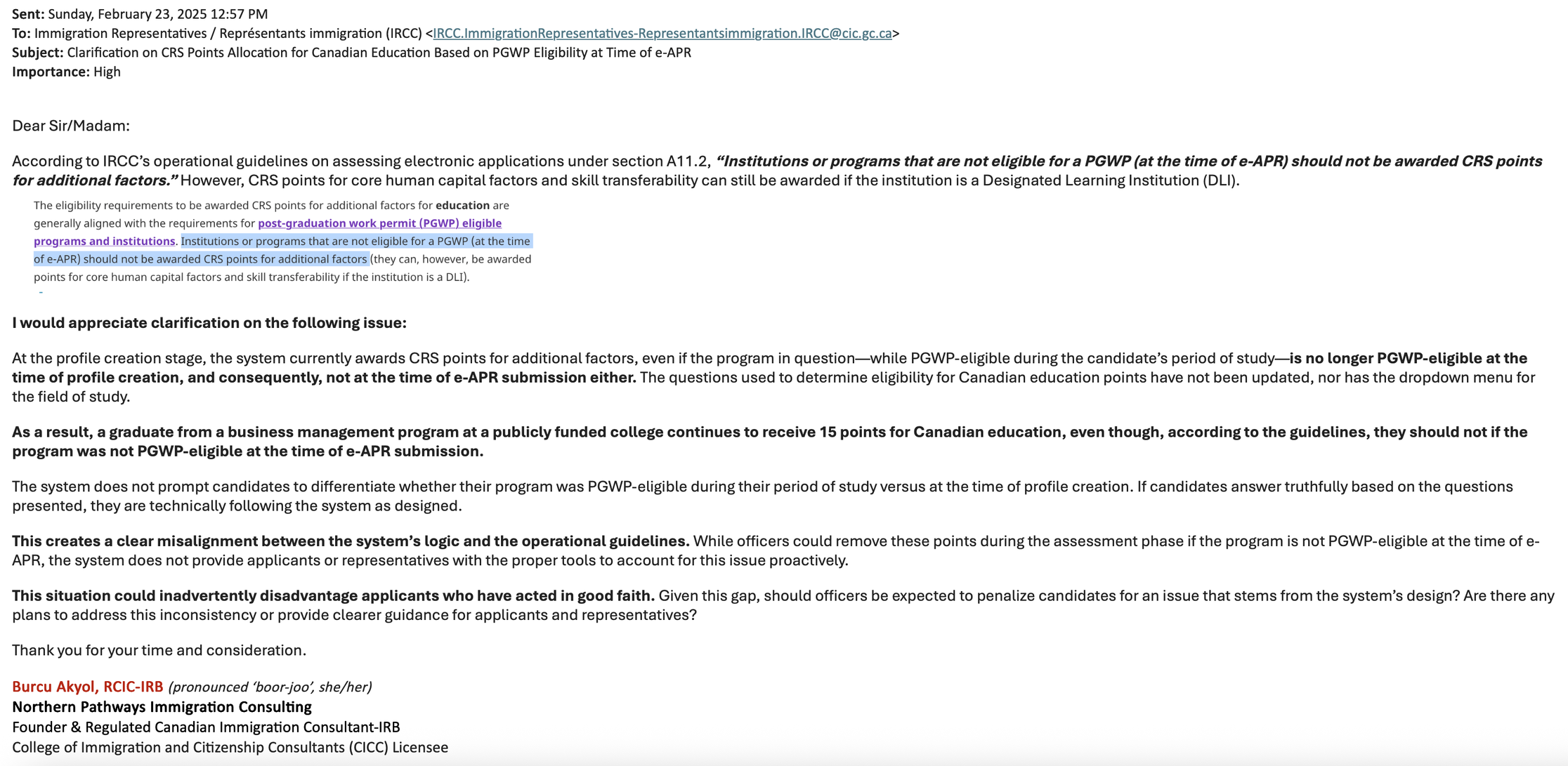
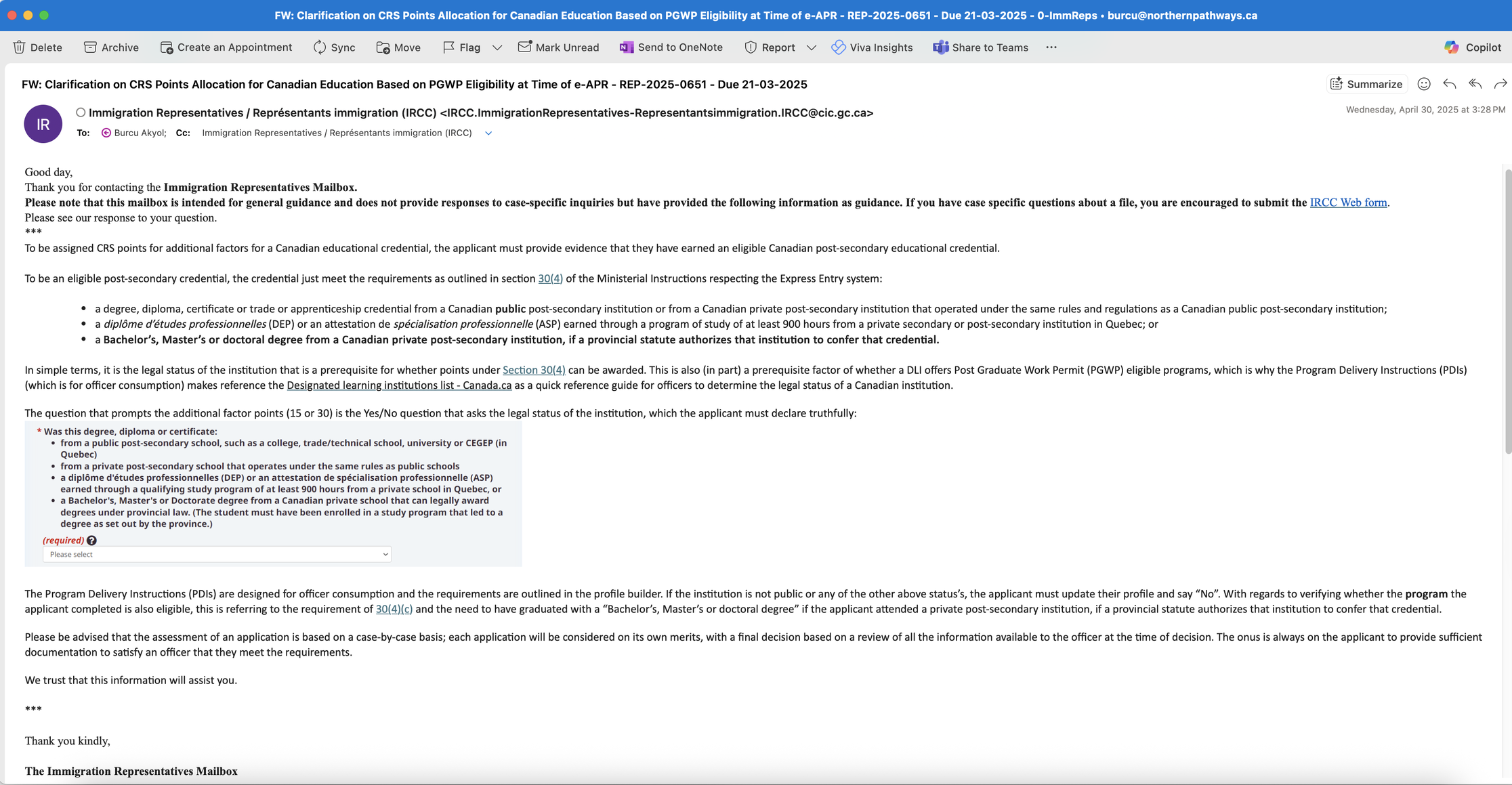
In February 2025, I raised this issue with IRCC’s Immigration Representatives mailbox. In April 2025, I received a response. In May 2025, I addressed it in an article under “Issue 3: Confusion Caused by A11.2 Guideline on PGWP Eligibility for Canadian Education Points.”
At the time, I moved on.
But the issue continues to surface in practice. A recent review of GCMS notes for an unrelated matter reinforced concerns about a structural misalignment between system design and assessment.
This article sets out the issue clearly.
1. The Legal Framework: Section 30(4) Ministerial Instructions
Section 30(4) of the Ministerial Instructions defines what qualifies as an eligible Canadian post-secondary credential for additional CRS points.
The definition focuses on:
- The legal status of the institution
- Whether it is public or certain qualifying private institutions
- The type of credential
- Provincial authority to confer degrees
While the section 30(4) definition broadly parallels the types of institutions and credentials that have historically aligned with PGWP eligibility, it does not explicitly incorporate program-level PGWP eligibility as a requirement for awarding additional CRS points, nor does it clearly anchor the analysis to PGWP status at the time of e-APR.
Historically, institutional eligibility and PGWP eligibility often aligned in practice. With the introduction of program-level restrictions, including field-of-study criteria, that alignment no longer consistently exists.
2. What A11.2 Operational Guidance Adds
Operational guidance under A11.2 includes language to the effect that:
Institutions or programs that are not eligible for a PGWP (at the time of e-APR) should not be awarded CRS points for additional factors.
This wording introduces two filters that are not expressly embedded in section 30(4):
- Program-level PGWP eligibility, not merely institutional status
- A time-of-e-APR test, rather than a time-of-study test
That distinction matters.
3. The Express Entry Profile Question Does Not Capture This Filter
The Express Entry profile question that triggers additional Canadian education points asks:
Was this degree, diploma or certificate:
- from a public post-secondary school, such as a college, trade/technical school, university or CEGEP (in Quebec)
- from a private post-secondary school that operates under the same rules as public schools
- a diplôme d’études professionnelles (DEP) or an attestation de spécialisation professionnelle (ASP) earned through a qualifying study program of at least 900 hours from a private school in Quebec, or
a Bachelor’s, Master’s or Doctorate degree from a Canadian private school that can legally award degrees under provincial law. (The student must have been enrolled in a study program that led to a degree as set out by the province.)
The structure of the question:
- Centres on institutional category
- Uses past tense
- Encourages answers based on facts at the time of study
It does not ask:
- Was your specific program PGWP-eligible?
- Is it PGWP-eligible at the time of e-APR?
- Has the program lost eligibility due to field-of-study restrictions?
Depending on the credential, the system awards:
- 15 additional CRS points (for one- or two-year credentials), or
- 30 additional CRS points (for three-year or longer credentials, Master’s, professional degrees, or doctorates). A three-year advanced diploma also triggers 30 additional CRS points. With recent program-level restrictions, including field-of-study criteria, some advanced diploma programs are no longer PGWP-eligible, making any subsequent CRS recalculation more consequential.
The system awards these points automatically at profile stage.
The issue does not typically arise at the ITA stage.
It arises later.
4. Where the Real Risk Appears: e-APR Assessment
At the e-APR stage, officers assess eligibility under A11.2.
If, at assessment, an officer applies the operational guidance that links eligibility for additional Canadian education points to PGWP eligibility at the time of e-APR, and concludes that the institution or the specific program was not PGWP-eligible at that time, the officer may:
- Recalculate the CRS score
- Remove the 15 or 30 additional points
- Reassess whether the applicant would still have met the round’s cut-off
If removal of those points drops the score below the cut-off, this can result in refusal under A11.2.
This concern is grounded in the wording of operational guidance and in assessment notes recorded in GCMS.
5. A Real Example from GCMS Notes — and the Harder Scenario
Recently, I reviewed GCMS notes for a consultation client (shared with consent and fully anonymized). The GCMS notes were obtained for an unrelated matter, but the officer’s commentary is relevant to this discussion.
In that case:
- The applicant had been awarded 15 additional CRS points for Canadian study at the profile stage.
- The institutional category selected in the profile was incorrect (a private college credential was treated as if it met the “public post-secondary” category).
- The officer recalculated the CRS score and removed the additional points.
The GCMS notes stated:
PA indicated a score of 15 points for Canadian Study under Additional Points – Institutions or programs that are not eligible for a PGWP (at the time of e-APR) are not awarded the Additional CRS Points for Canadian study. Above revised points indicated – PA still meet minimum points at ITA.

In this file, the recalculation was appropriate because the profile answer itself was wrong. The officer was correct to reassess the additional points.
However, that is not the more difficult scenario.
To be clear, this is a separate scenario from the GCMS example above. In this scenario, the applicant:
- Relied on the rules in place at the time of study.
- Answered the profile questions truthfully.
- Met the published definition under section 30(4).
But due to later policy changes, including field-of-study restrictions, the program is no longer PGWP-eligible at the time of e-APR. If additional CRS points are removed on that basis alone, it raises a fairness concern, particularly where the Express Entry profile questionnaire does not clearly capture program-level PGWP eligibility at the relevant time point.
There are applications currently in process where this timing issue may arise. We will see how they are assessed.
6. Why This Is a Structural Problem
The concern is not that officers verify eligibility.
The concern is this:
The Express Entry system does not ask applicants questions capable of capturing the decisive PGWP-at-time-of-e-APR test that appears in operational guidance and GCMS notes.
There is a disconnect between:
- Ministerial Instructions
- Operational guidance
- Profile questionnaire design
- Scoring logic
Applicants may answer truthfully yet still face recalculation later because the system did not ask the relevant question. Applicants may answer truthfully yet still face recalculation later because the system does not explicitly capture the relevant program-level eligibility question.
7. The April 2025 ImmReps Response
When I raised this issue in February 2025, the April 2025 response:
- Reiterated section 30(4)
- Emphasized institutional legal status
- Stated that assessment is case-by-case
- Confirmed that the onus remains on the applicant
The response was not incorrect.
But it was not helpful in resolving the structural question.
It did not address how applicants are expected to reconcile a profile questionnaire grounded in institutional status with an assessment framework that applies program-level PGWP eligibility at the time of e-APR.
I am sharing both my original question and the ImmReps response below for transparency.
8. What Needs to Change
Two reforms would restore alignment.
1. Align the Legal Framework
If PGWP eligibility at the time of e-APR is determinative for awarding additional CRS points, that requirement should be clearly integrated into the Ministerial Instructions.
But timing is critical.
If PGWP eligibility is used as a filter, it should be assessed based on the program’s eligibility at the time of study and completion, not at the time of e-APR.
Otherwise, policy changes create retroactive unfairness for applicants who completed programs under different rules.
A coherent framework must clearly specify the relevant time point.
2. Update the Express Entry Profile Questionnaire
If program-level PGWP eligibility is relevant, the system should explicitly ask:
- Whether the program was PGWP-eligible at the time of study and completion
- Any relevant program-level eligibility factors
Without this, the system will continue to award 15 or 30 points at profile stage based on institutional status, while assessment may apply a different filter later.
That gap creates avoidable A11.2 exposure.
9. Why I Filed an ATIP Request
Because public guidance did not resolve the issue, I recently submitted an Access to Information request seeking:
- Internal instructions on how A11.2 is operationalized in these scenarios
- Business rules governing Express Entry scoring logic
- Internal discussions regarding program-level PGWP eligibility and field-of-study restrictions
Transparency clarifies expectations for applicants and representatives.
Closing
Express Entry is built on objective scoring.
When legal definitions, operational guidance, and system architecture are aligned, the system works as intended.
When they are not aligned, applicants and representatives absorb the risk.
Clarity matters in a points-based system.
I am sharing my February 2025 question and the April 2025 ImmReps response below. I will provide updates once the ATIP response is received.